Homes Worth Fixing. Neighbors Worth Investing In.
Homes worth fixing
When a roof leaks or a front step becomes unsafe, the answer shouldn't be to give up on the home. It should be to make the repairs that help someone keep living there safely.
Yet when homeowners cannot afford essential repairs, manageable problems can become major hazards—putting both the home and the person living in it at risk.
At Rebuilding Together Pittsburgh, we know that addressing housing needs isn't just about building new homes. It's also about preserving the homes we already have.
That's the message behind Rebuilding Together's national Fix18 campaign. We're proud to be part of this national effort.
The campaign's central comparison is striking: for the cost of building one new home, Rebuilding Together can repair 18 existing homes. It's a powerful reminder of the potential of investing in home repair, particularly across Allegheny County, where many neighborhoods have vacancy rates higher than the national norm.
Looking beyond countywide numbers
Countywide housing statistics don't tell the whole story.
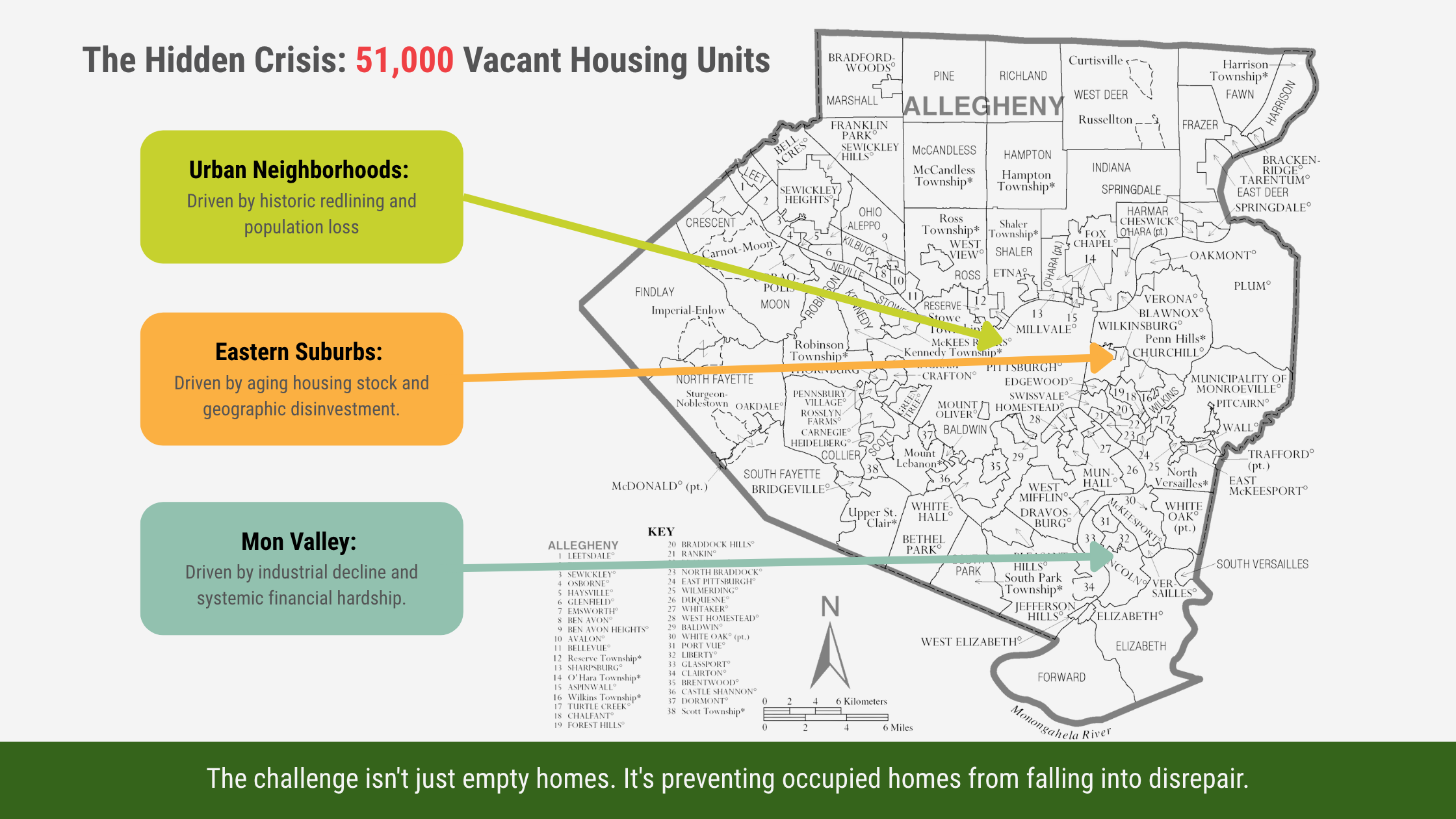
A 2022 report citing U.S. Census Bureau estimates found that Allegheny County had more than 51,000 vacant housing units in 2020, including apartments. That is not a count of abandoned or deteriorating homes. But the report identified concentrations of vacancy in the Mon Valley and Pittsburgh neighborhoods affected by population loss and disinvestment, along with substantial vacancy across communities in the eastern suburbs.
The challenge is not simply how many homes are empty. It is also how to keep occupied homes safe and livable before repair needs become overwhelming.
Preservation means helping homeowners address those needs before a leaking roof, unsafe stairs, or an inaccessible entrance threatens their ability to stay.
Understanding the roots of disrepair
Housing conditions do not exist apart from history. In Pittsburgh and its suburbs, redlining and racially restrictive housing practices limited where Black families could live and their access to wealth-building opportunities through homeownership. Their effects continue to shape inequality in our region.
That history is an important part of understanding disinvestment—but it is not the only factor behind vacancy and deterioration. Population loss, financial hardship, low property values, and the high cost of repairs have also contributed to the problem.
Recognizing these overlapping challenges helps us understand why repair needs can become overwhelming—and why bringing resources to homeowners and communities that have experienced disinvestment matters.
Preserving homes, supporting neighbors
New construction and home preservation are not competing solutions. Both have a role to play. Building new housing matters, but so does keeping existing homes safe, accessible, and livable.
At Rebuilding Together Pittsburgh, we provide free, comprehensive home repairs and rehabilitations to qualifying homeowners. Our work includes safety improvements, accessibility modifications, and energy-efficiency measures that support older adults, veterans, people with disabilities, and families with low incomes.
A roof repair can protect a home from further damage. A ramp can help a neighbor enter and leave their home more independently. These improvements help people remain safely housed while preserving the homes they depend on.
Fix18 puts that work in focus: homes are worth fixing, and the people who live in them are worth investing in.
We cannot undo decades of disinvestment with a single repair. But we can address urgent needs, one home at a time, while contributing to a broader effort to strengthen our communities.
When we help a neighbor stay safely housed, we do more than repair a building. We help preserve a place to belong.
Want to learn more about the national campaign? Visit Fix18.org to see why homes are worth fixing.
Want to make an impact locally? Donate today to help us continue this vital work right here in Pittsburgh.
Sources
- Jeffery Fraser, "Opportunity Awaits, but...", Pittsburgh Quarterly, May 30, 2022.
- David S. Rotenstein, "Built for white people: The hidden racist history of some Pittsburgh neighborhoods", PublicSource, April 8, 2024.
- Western Pennsylvania Regional Data Center, "Redlining Maps from the Home Owners Loan Corporation, 1937".